Articles
Why Choose Design Sprints in Web3 Startups
Dec 18, 2025

Rushed launches and shifting priorities leave many blockchain founders searching for ways to cut through uncertainty without wasting resources. Design sprints, an agile approach pioneered at Google, offer a structured path to rapid prototyping and user validation in just five days. For startups navigating complex Web3 challenges, this method delivers a flexible framework to test assumptions, minimize risks, and take actionable steps toward market-ready solutions faster than traditional cycles.
Table of Contents
Key Takeaways
Point | Details |
|---|---|
Rapid Problem Solving | Design sprints compress months of work into a focused five-day process, allowing for quick prototyping and testing. |
Flexibility and Adaptation | Sprints are adaptable methodologies that prioritize human-centered design and cater to the unique challenges faced by Web3 startups. |
Collaboration is Key | Effective design sprints foster cross-functional team collaboration and leverage digital tools to enhance communication and prototype validation. |
Focus on Learning | Teams should treat design sprints as strategic experiments to learn and iterate, rather than seeking definitive solutions from the outset. |
What Design Sprints Are and Misconceptions
Design sprints represent a strategic approach for rapidly solving complex problems in product development, particularly crucial for Web3 startups navigating uncertain technological landscapes. Design sprints pioneered at Google have evolved into a powerful methodology that condenses months of work into a focused five-day process.
At their core, design sprints are structured innovation workshops that enable teams to quickly prototype, test, and validate ideas with minimal resources. Key characteristics include:
Compressed timeline (typically 5 days)
Cross-functional team collaboration
Rapid prototyping and user testing
Risk mitigation through early validation
Actionable insights generated quickly
Contrary to common misconceptions, design sprints are not extended development cycles or rigid problem-solving frameworks. They are dynamic, flexible processes that embrace uncertainty and prioritize human-centered design principles. Web3 startups particularly benefit from this approach, as blockchain and decentralized technologies demand rapid adaptation and innovative problem-solving.
Prototype Validation is the heart of design sprints. Teams create low-fidelity mockups, test them with real users, and gather immediate feedback. This approach allows startups to pivot or refine concepts before significant resource investment.
Design sprints transform abstract ideas into tangible solutions, reducing risk and accelerating innovation in just five concentrated days.
Pro tip: Treat design sprints as strategic experiments, not definitive solutions - their true value lies in learning and rapid iteration.
Types of Design Sprints for Startups
Web3 startups leverage multiple design sprint approaches tailored to their unique innovation challenges. Design sprint methodologies demonstrate remarkable adaptability across different problem-solving scenarios, enabling teams to rapidly validate concepts and mitigate technological risks.
Three primary types of design sprints emerge as particularly valuable for blockchain and decentralized technology ventures:
Classic Five-Day Sprint
Comprehensive problem exploration
End-to-end prototype development
Full user testing and validation cycle
Feature Prioritization Sprint
Focused on identifying critical product features
Rapid stakeholder alignment
Quick decision-making framework
Innovation Culture Sprint
Transforming team mindset
Breaking traditional development barriers
Encouraging experimental thinking
Methodological approaches vary significantlybased on team composition, prior experience, and specific project requirements. Successful startups integrate digital collaboration tools like cloud-based whiteboards and advanced design systems to enhance sprint efficiency.
Design sprints are not one-size-fits-all; they are flexible frameworks adaptable to each startup's unique challenges and technological landscape.
Digital Collaboration plays a crucial role in modern design sprints. Teams leverage cutting-edge tools to simulate, prototype, and validate ideas without significant upfront investment, dramatically reducing time-to-market for Web3 innovations.
Pro tip: Select your design sprint type based on your most pressing current challenge - alignment, feature development, or cultural transformation.
How the Design Sprint Process Works
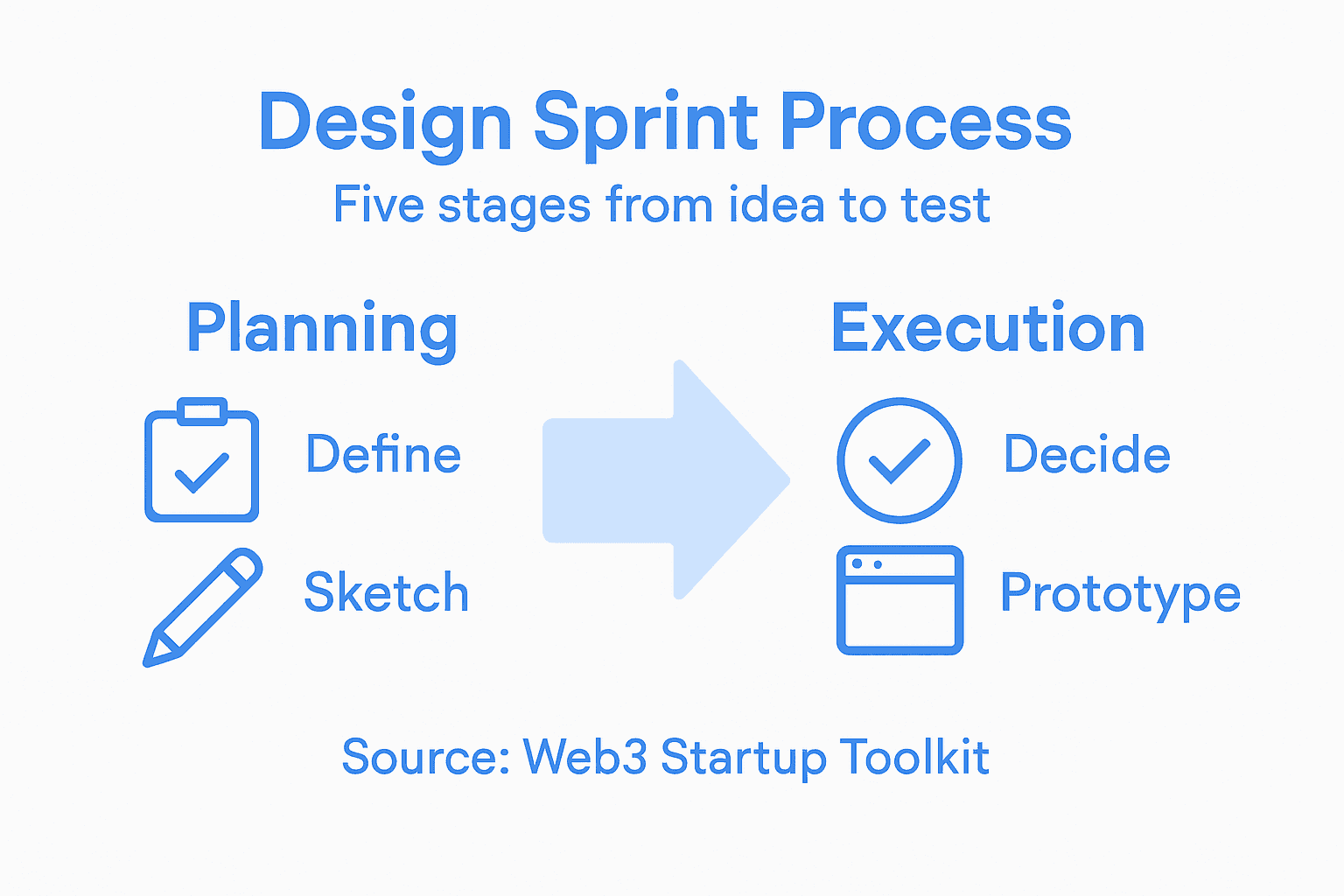
Design sprint processes involve structured, time-boxed activitiesthat transform complex challenges into actionable solutions within an intense five-day framework. These methodical approaches enable Web3 startups to compress months of traditional development into a concentrated innovation cycle.
A typical design sprint unfolds across five critical stages:
Challenge Understanding
Define precise problem boundaries
Map current technological landscape
Identify specific user pain points
Ideation and Sketching
Generate multiple solution concepts
Explore diverse technological approaches
Create rapid visual representations
Solution Decision
Evaluate potential prototypes
Align with strategic objectives
Select most promising concept
Prototype Development
Build low-fidelity model
Simulate core functionality
Prepare for user testing
User Validation
Conduct targeted user interviews
Gather immediate feedback
Assess concept viability
Collaborative digital tools enhance real-time design iterationby enabling teams to share, modify, and validate ideas simultaneously. Advanced platforms like cloud-based whiteboards and collaborative design systems allow geographically distributed teams to maintain seamless communication throughout the sprint.
Effective design sprints transform abstract concepts into tangible prototypes, reducing development risks and accelerating market entry.
Digital Collaboration remains crucial in modern design sprints. Sophisticated communication technologies enable teams to simulate, prototype, and validate ideas without significant upfront investment, dramatically reducing time-to-market for innovative blockchain solutions.

Pro tip: Assign clear roles and time limits for each sprint stage to maintain focus and prevent scope creep.
Key Benefits for Fintech and Blockchain Teams
Crypto design sprints provide strategic advantagesfor fintech and blockchain teams navigating complex technological landscapes. By compressing traditional development timelines, these focused workshops enable rapid hypothesis testing and innovative problem-solving specific to decentralized technology challenges.
Key benefits for blockchain and fintech teams include:
Accelerated Validation
Rapid testing of tokenomics models
Quick assessment of security workflows
Fast user onboarding flow evaluation
Cross-Functional Alignment
Integrate perspectives from product teams
Incorporate engineering insights
Ensure legal and compliance considerations
Risk Mitigation
Minimize investment uncertainties
Validate concepts before full development
Reduce potential market entry failures
Design sprints create collaborative environmentsthat break down traditional organizational silos. By bringing diverse expertise together, teams can overcome technical complexity and regulatory uncertainties more effectively than conventional development approaches.
Blockchain innovation thrives on rapid iteration and cross-functional collaboration - design sprints provide the perfect framework for this approach.
Competitive Advantage emerges from these intensive workshops. Teams can deliver customer-centric solutions faster, test radical ideas with minimal risk, and maintain flexibility in a rapidly evolving technological ecosystem.
Pro tip: Invite team members from different departments to your design sprint to maximize diverse perspectives and comprehensive problem-solving.
When to Use Sprints Versus Other Tools
Design method selection depends on project complexity and specific organizational challenges. Web3 startups must strategically choose between design sprints and alternative innovation frameworks to maximize their problem-solving effectiveness.
Key comparison points between design sprints and other tools:
Here's a comparison of design sprints with other popular innovation approaches for startups:
Criteria | Design Sprint | Design Thinking | Agile Development |
|---|---|---|---|
Core Focus | Quick prototype & test | Deep user insights | Iterative feature delivery |
Typical Duration | Five days | Weeks to months | Ongoing cycles |
Ideal Use Case | High-risk decisions | Complex, unclear problems | Continuous product updates |
Outcome Type | Tested prototype | Rich user understanding | Shippable product increments |
Design Sprints
Ideal for high-risk, well-defined challenges
Rapid prototyping and validation
Five-day compressed timeline
Focused on actionable outcomes
Design Thinking
Broader, more exploratory approach
Longer discovery and ideation phases
Deeper user need understanding
Less time-constrained
Agile Development
Iterative product development
Continuous improvement cycles
Ongoing feature refinement
Longer-term implementation focus
Design frameworks offer different problem-solving approachestailored to specific organizational needs. Startups can blend methodologies to create hybrid approaches that leverage the strengths of each innovation technique.
The right tool depends on your specific challenge: sprints for quick validation, design thinking for deep exploration, agile for continuous improvement.
Strategic Selection involves understanding your team's current stage, problem complexity, and desired outcomes. No single approach fits every scenario, making flexible methodology crucial for Web3 innovation.
Pro tip: Assess your project's specific needs by evaluating the urgency of validation, depth of exploration required, and available team resources before selecting a methodology.
Common Pitfalls and How to Avoid Them
Design sprint challenges often emerge from team dynamicsand inadequate preparation. Web3 startups must proactively address potential obstacles to ensure sprint success and maintain team momentum.
Common design sprint pitfalls include:
Process Distrust
Skepticism about sprint methodology
Resistance to structured innovation
Undermining collaborative potential
Time Management Issues
Failing to adhere to time constraints
Over-discussing instead of deciding
Allowing scope creep
Team Behavior Problems
Disruptive participant interactions
Unequal contribution levels
Lack of psychological safety
Sprint success requires proactive management strategiesthat address potential roadblocks before they derail progress. Effective facilitation involves creating an environment of trust, maintaining strict time boundaries, and gently redirecting team energy.
Below is a summary of the most common pitfalls in design sprints and corrective strategies:
Pitfall | Likely Impact | How to Address |
|---|---|---|
Process Distrust | Poor engagement | Early education on sprint value |
Time Mismanagement | Incomplete sprint outcomes | Use visual timers and strict agendas |
Team Behavior Issues | Reduced creativity, tension | Set clear rules, encourage openness |
Successful design sprints are less about perfect execution and more about maintaining focus, momentum, and collaborative spirit.
Stakeholder Engagement remains critical in preventing sprint failures. Continuous communication, clear expectations, and realistic workload assessments help teams navigate potential challenges and maintain productive sprint dynamics.
Pro tip: Conduct a brief pre-sprint alignment meeting to establish ground rules, expectations, and create a shared commitment to the sprint process.
Accelerate Your Web3 Startup Growth with Expert Design Sprints
Navigating the complex and fast-evolving Web3 landscape demands focused innovation and rapid validation. If your team faces challenges like aligning cross-functional stakeholders or quickly testing blockchain-based user experiences, design sprints provide a proven way to reduce risk and speed up development cycles. The article highlights how design sprints enable Web3 startups to compress months of work into just five days, delivering actionable insights and early user feedback that help you pivot before investing heavily.
Unlock the true potential of your product with design sprints tailored for blockchain and fintech innovation. At alexandroff.design, specialized UX/UI design services focus on rapid project execution—completing up to 80 percent of your design backlog within 30 days. Benefit from bespoke sprint collaborations, flexible pricing, and a portfolio proven by clients like Marinade Finance and Kamino. Ready to move from uncertainty to clarity? Explore how design sprints and focused UX strategies can transform your Web3 startup today.
Frequently Asked Questions
What are design sprints and how do they work?
Design sprints are structured workshops that condense a complex problem-solving process into a focused five-day framework. Teams define challenges, brainstorm solutions, create prototypes, and validate ideas through user testing in this intensive period.
Why are design sprints particularly beneficial for Web3 startups?
Web3 startups face unique challenges due to the rapidly evolving technology landscape. Design sprints allow these startups to quickly test and validate ideas, pivot as needed, and reduce the risks associated with significant resource investments in uncertain development phases.
How do design sprints differ from traditional development cycles?
Design sprints are designed to be dynamic and flexible, concentrating on rapid prototyping and user feedback within a short timeframe, unlike traditional development cycles which can take months and may involve prolonged planning and execution without user input.
What common pitfalls should startups avoid during design sprints?
Common pitfalls include process distrust, time management issues, and team behavior problems. To avoid these, ensure clear communication of the sprint's value, adhere to time constraints, and foster a collaborative environment where all voices are heard.